
Crack spraying.
Crack detection systems for the highest quality requirements.
Crack spraying.
Crack detection systems for the highest quality requirements.
Sophisticated crack detection technology — because safety knows no compromise
Non-destructive crack detection plays an important role as a quality assurance tool, particularly for safety-relevant and cost-intensive components. We create safety at this point with our manual, semi-automatic and fully automatic systems. These work according to the principle of the penetrant method, one of the most widely used crack testing methods in the field of non-destructive material testing.
We are also happy to manufacture process combinations for you according to your requirements, such as pickling or cleaning with downstream crack detection. Just like the rest of our production program, our crack detection systems are tailored to the individual needs of each customer.
You receive everything from a single source: from design and production to assembly, including automation — exactly as you need it!
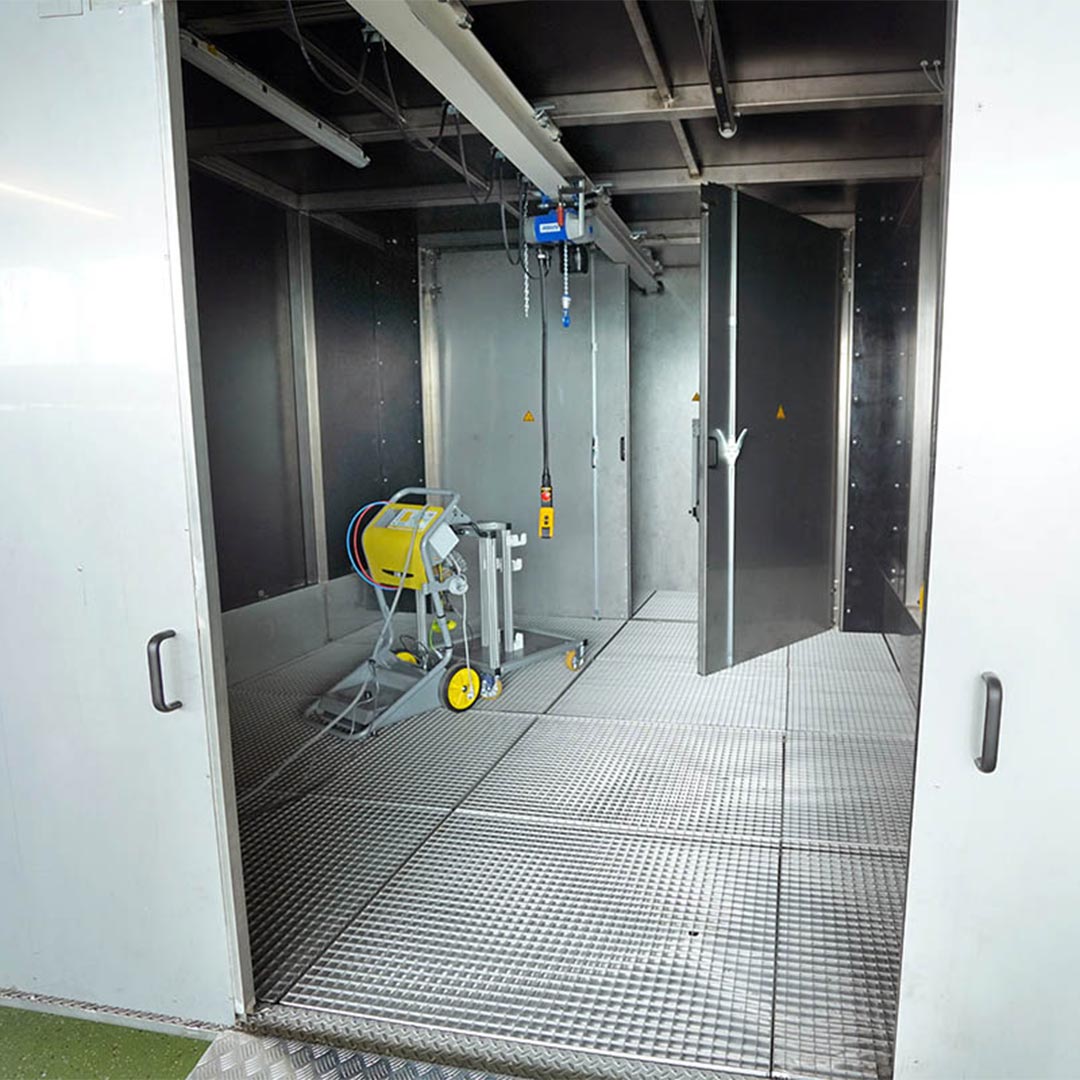
Crack spraying procedure.
Non-destructive crack testing using the penetrant method
The process, which is based on the physical law of capillary action, is universally applicable and can be used regardless of the material in question.
- 1The materials are fed to the test in their initial state.

- 2It must be ensured that the materials to be inspected and any cracks in them are clean and dry. If necessary, the materials are pre-cleaned at this point.

- 3The penetrant is then applied by dipping or spraying and must then be left to work for a sufficiently long time.

- 4During intermediate cleaning, the agent is removed from the surface, but not from the cracks. In the emulsifying process, the emulsifier is now applied and also only removed from the surface. This leaves the residue of the agent in the cracks.

- 5After drying, a developer is applied, which pulls the remaining penetrant out of the cracks like a blotting paper. Depending on the penetrant used, the defects become visible either directly or under UV light.

Our services
at a glance.
at a glance.
We look forward to hearing from you.